Categories
India activist ends hunger strike after 26 days
India's 'cockroach' protesters hold talks with government as stalemate continues
To play this video you need to enable JavaScript in your browser.
This video can not be played
Explained: Why have thousands taken to the streets in India?
- Published23 July 2026
Thousands of people continue to protest demanding the Indian education minister's resignation after representatives of the Cockroach Janta Party (CJP) held talks with the government.
CJP spokesperson Ashutosh Ranka told reporters that the government has asked for a day to decide on their biggest demand - minister Dharmendra Pradhan's resignation.
"The protest will continue and will keep growing until Dharmendra Pradhan resigns. If that does not happen soon, we will be forced to announce another nationwide protest call," said Ranka.
The protests, which began more than a month ago, gained momentum this week after a police crackdown on people marching to parliament left dozens injured.
The protests are led by CJP, an online satirical movement that has evolved into a powerful platform for young people's anxieties and dissent.
Saurav Das, another CJP spokesperson, said the government had responded positively to two other demands: compensation for the families of students who reportedly died by suicide after the cancellation of a major medical entrance exam in May, and the withdrawal of police cases against protesters who joined the march to parliament. He said the two sides would meet again on Saturday.
Federal minister JP Nadda told reporters that the government would inform CJP on Saturday "about the discussion we had among the government".
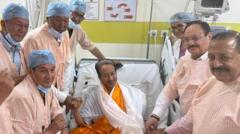
The meeting followed an eventful night where activist Sonam Wangchuk ended his hunger strike after 26 days of fasting in solidarity with the protests.
A short while before that, Prime Minister Narendra Modi also posted a video promising a tough new law on examination paper leaks, the issue at the core of the protests.
The protests have become a major headache for Modi's government, which had tried to ignore them in the first few weeks.
That changed last Saturday, when authorities forcibly removed Wangchuk from the protest site and admitted him to hospital, citing health concerns.
Two days later, police in Delhi cracked down on protesters attempting to march to parliament, sparking massive public anger.
On Thursday night, Modi posted a video message - shot vertically, seen as an attempt to reach the young protesters who are active on Instagram - saying that a tough new law on examination paper leaks was being prepared.
He said he had received a draft of the law, which they wanted to introduce soon in parliament.
Exam paper leaks are at the centre of the controversy - India has witnessed dozens of them over the past couple of decades. The latest trigger was the leak of the question paper for the medical entrance exam, National Eligibility cum Entrance Test (NEET).
Nearly 2.28 million candidates sat the exam on 3 May. It was cancelled days later, and a re-test was held.
Wangchuk (centre) ended his fast last night in the presence of federal ministers
Why are thousands protesting for education reform in India?
The hunger-striking engineer demanding education reforms in India
CJP protest: The youth movement India's Modi didn't see coming
While Modi did not address the protests directly, he said he was "well aware that the issue of paper leaks is not a small matter".
"It causes immense distress to [hundreds of thousands] of students and their parents," he said, reiterating his earlier promise to strengthen the legal framework to punish culprits.
But the CJP reiterated they would not back down on the demand for Pradhan's resignation.
"The fact that Modi had to make a selfie [video] at midnight shows the pressure he's under. He has promised to take action - the best he can do is sack his education minister," Ranka told the BBC earlier on Friday from the protest site.
Wangchuk said that he was ending his hunger strike after the government assured him no legal action would be taken against protesters at Jantar Mantar, the main protest site in Delhi, and those who marched to parliament.
He said he had also received assurances that the NEET paper leak, accountability in the examination system and wider examination reforms would be discussed in parliament.
But he said he had received no specific promise on Pradhan's resignation.
After he ended his fast, Abhijeet Dipke, the founder of CJP, posted: "We are relieved and grateful that Sonam sir has ended his hunger strike after 26 days. Thank you, sir, for your extraordinary courage and sacrifice. By putting your own life on the line, you awakened the conscience of an entire nation. Your life is far too precious to this country."
On Friday, the atmosphere at Jantar Mantar was loud and enthusiastic.
Hundreds of young protesters had spent the night sleeping on roads and pavements, chanting slogans demanding Pradhan's resignation and urging Modi to sack him.
Pradhan has not commented on the demand but earlier criticised the opposition Congress party for "shamelessly [exploiting] students as political tools to manufacture disruption".
Many protesters said they were relieved Wangchuk had ended his fast.
"He [Wangchuk] was fasting for a long time, could have lost his life and we didn't want that. He's done a lot for the nation, for the youth. We are happy he's broken his fast. We pray for his health," said Fabiha Sayyed, a 23-year-old corporate worker who is at the protest site.
Security has been tightened in the area, with a heavy police presence, mobile internet suspended in several areas and 18 metro stations closed.
The crowd underscored CJP's rise into one of India's most visible youth movements and one of the biggest public displays of dissent against the Modi government since it took office in 2014.
The CJP emerged in May from a comment by India's top judge, who compared unemployed young people drifting towards journalism and activism with cockroaches and parasites. He said later that he was referring specifically to people with "fake and bogus degrees", not India's youth more broadly.
The CJP later began protesting against paper leaks and other irregularities in India's top exams and has gained a massive following on social media. The protesters have been demonstrating for more than a month now.
Follow BBC News India on Instagram, external, YouTube,, external Twitter, external and Facebook, external.