The Assyrian Flag
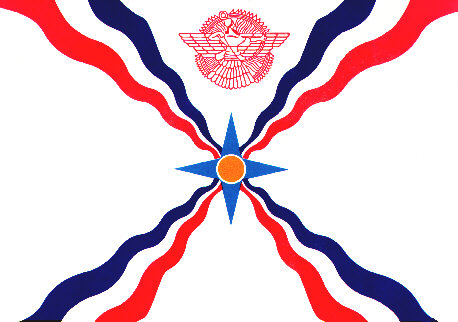
the aftermath of the inception of Assyrian Universallliance in 1968, a serious effort was undertook by this organization to addresshe need for the Assyrian nation to have its own official flag. To realize thisream, it was decided to appeal to various Assyrian artists and knowledgeableeople, for the purpose of soliciting ideas and layouts on this importantational task. In order to be presented to the AUA Congress for approval,ayouts and suggestions were to be collected from the across the world.ldwide effort nettedarge number of designs, which were duly received and noted. Followingeticulous consideration, a decision was reached in favor of one particularesign, which best captured the Assyrian essence from the past and the present.
n the year 1974, this design was approved by the 6th congress of theUA, which convened the United States in the city of Yonkers, NY. A well-knownssyrian artist, Mr. George Bit-Atanus of Teheran, Iran, designed this flag. Theain reason for the approval of this flag was that the artist had not merelyresented his own views. Rather, he had brilliantly blended ancient Assyrianesigns representing the former glory of the Assyrian Empire, to create anttractive fusion between the past and the present. In this way the artist haducceeded to bridge the gap between a glorious Assyrian past, and theresent-day struggles and ambitions of the Assyrian nation. Assyrian flag is designed with a white background on whichhree waving stripes emerge from each corner of a center design. The design isn the shape of four-headed star. At its center, the star encompasses a goldenircle representing Shamash, the Assyrian Sun-God who was believed to give lifeo all things on earth. The four wedges of the star are a bright blue color andepresent happiness and tranquility.
 ng strips protrude fromhe four joints of the star and stretch to the four concerns of the flag. Thetripes are narrow at the base and become wider as they distance themselves fromhe center. They symbolize the three major rivers flowing through the land ofssyria. At the top we see the mighty Euphrates, represented in blue denotingbundance. In the center the great Zab is in white, portraying peace, and in theottom we see the mighty Tigris in a red color, representing the Assyrianational pride. These three stripes are also picturing the rays of the centertar and stand to symbolize the dispersion of the Assyrian people to the fourorners of the world. The manner in which these stripes emerge from the starlso symbolically portrays the eventual return of the Assyrians to theirncestral homeland, which is represented by the center of the star. over the star and themblem of Shamash, there is a representation of the image of God Ashur, thencient Assyrian supreme deity. The emblem of Ashur features the deity standingn circle with two eagle wings spanning and over stretching its length on twoides. Ashur has drawn a bow and his arrow is ready to fly. This is in the samehape and color scheme of the original ceramic work preserved in the Britishuseum. atop the flag there
stands the royal insignia the famous Assyrian king Sargon II, signifying theight and the great civilization achieved by the Assyrians.