Categories
Macron takes aim at ‘American free speech’
Macron takes aim at ‘American free speech’
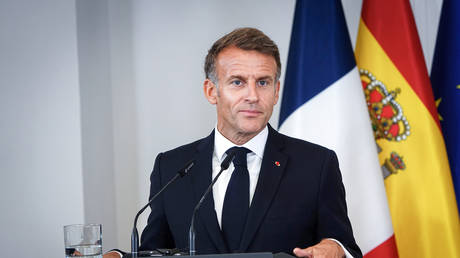
The French president has called for much tougher enforcement of the EU’s controversial online-content rules Published 2 Oct, 2026 04:10 | Updated 2 Oct, 2026 05:15French President Emmanuel Macron at Moncloa Palace in Madrid, Spain, September 30, 2026. © Pablo Cuadra / Getty Images
French President Emmanuel Macron has rejected what he described as “American free speech” as he defended the EU’s controversial Digital Services Act (DSA), which US officials have branded an instrument of censorship.
Speaking to reporters during a trip to Spain on Wednesday, Macron said he had asked the EU to enforce the DSA “much more extensively, much faster and much more forcefully” to tackle the spread of misinformation.
“The so-called American ‘free speech’ – at least as it exists today and has been promoted by some people – is the opposite of free speech,” Macron said, arguing that individual freedoms come with responsibilities and respect for the freedoms of others.
“I know this when I walk down the street: my freedom cannot mean that I am free to hit you, insult you or vandalize the public space that belongs to everyone. Yet that is some people’s idea of ‘free speech,’” he added.
“Until we hold those who disseminate content on social media accountable, we will not be able to regulate it,” the French leader said. “When someone writes something – when a journalist writes something completely false or an editor publishes it – they can be held accountable.”
Adopted in 2022, the DSA requires online platforms such as Facebook, X, TikTok, Google and YouTube to address illegal content, increase transparency around advertising and algorithms, protect minors, and assess and mitigate systemic risks such as disinformation. The largest platforms face additional obligations and can be fined up to 6% of their worldwide annual turnover for violations.
In December 2025, the EU imposed its first fine under the DSA, ordering Elon Musk’s X to pay €120 million ($140 million) for violating the law. Last month, the US government backed X’s appeal, arguing that the bloc had overstepped its authority in targeting an American company.
Read more US backs Musk’s X in legal battle with EU“We will not tolerate the European Commission engaging in regulatory overreach to try and control American engines of innovation and economic growth,” said Assistant Attorney General Brett Shumate of the Justice Department’s Civil Division.
US officials have accused the EU of eroding freedom of speech and attempting to silence dissenting voices for political reasons. “The EU should be supporting free speech not attacking American companies over garbage,” US Vice President J.D. Vance wrote on X in December.
Last year, the US imposed visa restrictions on European officials and heads of online monitoring groups, including Thierry Breton, the former EU internal market commissioner and a key architect of the DSA. Breton compared the move to McCarthyism, the Cold War-era campaign in the US against suspected communists and alleged subversives.
US President Donald Trump has also faced accusations of restricting press freedom. Last month, he barred CNN, MS NOW and Politico from the White House, accusing them of spreading “fake news.” A federal judge subsequently ordered their access restored, ruling that the outlets were likely to succeed in their claim that the ban was unconstitutional.
© Autonomous Nonprofit Organization “TV-Novosti”, 2005–2026. All rights reserved.
This website uses cookies. Read RT Privacy policy to find out more.