Categories
People trapped inside Japan shopping centre after earthquake
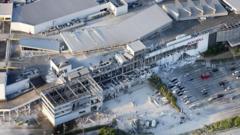
People missing in collapsed mall and factory after earthquake hits Japan
The fire department said the second floor of the mall collapsed, "leaving many people trapped inside"
Nineteen people remain missing at a collapsed shopping centre and a damaged paper factory after a strong earthquake hit south-western Japan.
A local disaster management official told the BBC four people were rescued and another 10 are missing after a blast at the Aeon Mall in Kashima, Kumamoto prefecture, following the magnitude 6.8 tremor.
In Yatsushiro City, two people were found in a state of "cardiac arrest" and nine are unaccounted for after a chimney collapsed at Nippon Paper's Yatsushiro Plant.
The quake hit Kyushu island at 16:27 local time (07:27 GMT) on Tuesday, with hundreds of thousands of people told to move to evacuation shelters. A tsunami warning was lifted within one hour.
The quake was strong enough to be felt in South Korea.
The Japan Meteorological Agency (JMA) reported it was a magnitude 7.1 tremor, which the US Geological Survey later measured as a 6.8. Quake magnitude figures are often updated as seismologists obtain and analyse new data.
The quake's shallow epicentre - with a depth of 10 km (six miles) - was about 20km south of Kumamoto city.
In nearby Kashima, the fire department said the Aeon shopping mall's "second floor collapsed".
Footage of the shopping centre shows white smoke rising from the building, as people run into the carpark. Large parts of the mall's exterior have been blown off, exposing the steel beams underneath.
An official from Kumamoto's disaster management division told the BBC the lives of the four rescued people at the mall were not in danger, but another 10 remained missing.
The official added that the prefecture was checking information about whether there had been a gas leak.
Aeon Mall is a popular nationwide chain that operates about 160 centres across Japan. It holds department stores, boutiques, pharmacies and food courts.
Elsewhere, footage aired by Japan's NHK broadcaster showed cracked roads and bridges and several buildings on fire. Train services were suspended and electricity cut off for thousands of homes.
NHK reported that dozens of people were injured during the earthquake. About 10 were in an elderly care home and at least 50 people were being treated in hospital.
"We are still assessing the extent of injuries and property damage, but I have been informed that there have already been several injuries," Japanese Prime Minister Sanae Takaichi said earlier in the day.
A bridge in the nearby Yatsushiro City partially collapsed after Tuesday's tremor
Felix Umland, a German photography student, was on the 13th floor of a hotel in Kagoshima, about 175km (109 miles) from the quake's epicentre.
"I just heard glasses flying in the kitchen and everything in the kitchen started breaking. There's not much you can do, it's a pretty hopeless situation. You're looking around waiting for it to stop," he told BBC's Newshour programme.
"In Japan the buildings are built to move with the earth but it feels like the building beneath you turns into liquid. It's a very surreal feeling. The solid ground just suddenly turned into a mass that was moving," Umland said.
The International Atomic Energy Agency posted to X that the earthquake "caused no damage or safety issues at the Sendai Nuclear Power Plant, located around 100km (62 miles) from the epicentre, and that it remains in operation".
"The IAEA will continue to monitor the situation," it said.
First responders have been deployed, including Japan's self-defence force, fire services and coast guard, Chief Cabinet Secretary Minoru Kihara said.
"We urge residents in areas where the shaking was particularly severe to pay close attention to evacuation information issued by local authorities via radio, television and the internet, and to act calmly," he said.
Takaichi said 3,600 soldiers would be deployed to help with disaster recovery as tremors continued. Japan's Meteorological Agency has reported more than 60 aftershocks ranging in magnitude from 1 to 4.
Japan is one of the world's most earthquake-prone countries, experiencing about 1,500 quakes a year.
In 2016, 278 people were killed in a series of powerful earthquakes in Kumamoto, NHK reported at the time.
Additional reporting by Jaroslav Lukiv