Categories
This key NATO state is headed for a perfect storm
This key NATO state is headed for a perfect storm
Türkiye’s ruling coalition is headed for a perfect storm of economic and political crises – it could choose to act before it breaks out Published 29 Jul, 2026 18:11By Mishel Bychkova, Vice-President, Center for Middle Eastern Studies (Moscow)
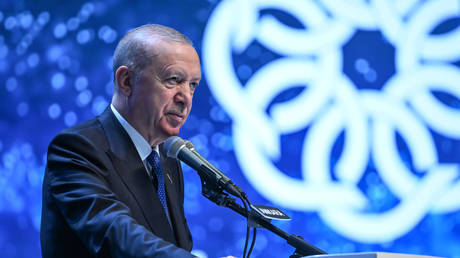
Turkish President Recep Tayyip Erdogan © Abdullah Guclu / Anadolu via Getty ImagesTurkish politics rarely stands still, but even by local standards, the past week has moved fast. Ozgur Ozel, the leader of the Republican People’s Party, told his parliamentary group that a new party will be formed within days.
On the surface, this looked like a routine reshuffling of parliamentary seats – the kind of maneuver that happens periodically in Ankara without lasting consequence. Underneath, it is nothing of the sort. The announcement was framed as a defensive move, yet its implications reach far beyond the corridors of the CHP. Against the backdrop of Türkiye’s stalling economy, the tense regional environment, and the unresolved Kurdish question, the birth of this new formation looks like the opening move in a broader contest over who controls the timing of the country’s next election. Taken together, the pieces suggest that Ankara is entering a period in which political survival, not policy, will dictate the pace of events.
Ozel did not describe his move as a rupture. He insisted that the CHP’s role as the parliament’s main opposition voice would not be abandoned, only carried forward under a new banner. The language was careful, almost defensive, and for good reason. Splitting a party while claiming continuity is a delicate balancing act, one that requires convincing both loyal voters and international observers that nothing essential has been lost in the transition. In practice, the plan is to bring roughly 85 deputies with him, instantly turning the new party into the second largest bloc in parliament and pushing the CHP itself down to 4th or 5th place. A party that has anchored Turkish opposition politics for a century is being hollowed out from within, not by an external rival but its own recent leader.
The logic behind the move becomes clear once the legal pressure on the CHP is taken into account. Courts have been steadily encroaching on the party’s internal affairs, including the reinstatement of Kemal Kilicdaroglu as the formal leader of the CHP. For Ozel, remaining inside a party whose leadership could be legally reassigned at any moment is a losing bet. Commentator Murat Yetkin described the new project as a reserve platform, built precisely so Ozel can wait out the legal storm without being dragged into seven months of an internal power struggle before elections arrive. This is an insurance policy, drafted by a politician who understands that Turkish courts have repeatedly proven capable of reshaping party leadership through rulings where ballots fail.
CHP falls back into Kilicdaroglu’s hands, Ozel keeps a functioning vehicle of his own, complete with parliamentary representation and a base of loyal deputies. If it does not work, he has lost remarkably little, since the new party can, in theory, be folded back into a friendly CHP once the legal dust settles. It is a move built for optionality rather than conviction, and that pragmatism is precisely what makes it significant. Ozel is betting that having control over a smaller, loyal formation beats having a contested claim over a larger, legally vulnerable one.
Read more How Türkiye went from problem child to power broker in NATOThe reaction in the press captures the split perfectly, and it is worth dwelling on because it previews how the story will be fought over in the months ahead. Cumhuriyet ran the story as a march toward power, presenting Ozel’s decision as painful but historic – a step taken for the good of the wider democratic camp. The framing was almost heroic, portraying a leader forced by circumstance into a bold act of political self-preservation on behalf of an entire opposition movement. Sabah took the opposite line, framing the new party as inheriting a corruption problem, naming several founding figures already tied to bribery investigations and describing Ozel’s supporters as having plundered the old CHP headquarters on their way out. The tone there was mocking and accusatory, designed to strip the move of any moral standing before it could gain traction with undecided voters. Two newspapers, two entirely different versions of Türkiye, and neither side is likely to soften its framing in the weeks to come.
None of this is happening in a vacuum. Türkiye’s banking sector is heading into a difficult second quarter, with net profits expected to fall by more than 20 percent as inflation expectations stay elevated and tight monetary policy pushes up the cost of financing. For a country that has leaned heavily on its banks to sustain consumer spending and keep growth numbers presentable, that is a signal that the buffer policymakers have relied on for the past several years is thinning when they can least afford it.
More troubling is the currency exposure building up in the real economy. Foreign currency liabilities among Turkish companies hit $392.4 billion in May, the highest level recorded since 2013, while the net foreign currency deficit reached $204.4 billion. Numbers on this scale are not abstract statistics for policymakers to just shrug off. They represent a private sector increasingly vulnerable to any depreciation of the lira, and a government with steadily shrinking room to maneuver on interest rates without triggering the kind of corporate distress these figures already hint at. Companies holding that much foreign currency debt need a stable or strengthening lira simply to service their obligations, which locks the central bank into a defensive posture regardless of what domestic conditions actually call for.
This is the trap facing Turkish economic policy right now. Tightening further to defend the currency risks strangling growth and deepening the sense of stagnation that voters already feel in their daily expenses. Loosening policy to stimulate the economy risks reigniting inflation and putting even more pressure on companies already struggling under record foreign currency exposure. There is no comfortable middle path left – only a series of trade offs that grow less forgiving with each passing quarter. And because Turkish monetary policy rarely operates independently of political considerations, every one of these trade offs eventually becomes a political decision as well, made with an eye on elections rather than purely on economic fundamentals.
Read more Trump’s flirting with Türkiye is making Israel squirmA region on edge and a question left unanswered at home
Türkiye’s foreign policy is not offering any relief either. Tensions with Israel remain unresolved, friction with Greece over Aegean and maritime issues continues to simmer, and the Cyprus question sits as stubbornly unsettled as it has for decades. Each of these fronts demands attention and resources from Ankara at a moment when the government would prefer to focus inward. None of them are new disputes, which in some ways makes the current moment more dangerous rather than less. Familiar tensions have a way of being taken for granted as innocuous right up until the moment they’re not. Meanwhile, Ankara now finds itself simultaneously managing several long running disputes while its domestic bandwidth is consumed by an economic downturn and a reshaped opposition.
The country’s relationship with Israel, in particular, carries reputational weight far beyond its immediate bilateral stakes. It shapes how Türkiye is perceived across the region, as well as among Western partners whose goodwill matters for investment and financing. Meanwhile, the dispute with Greece touches on questions of sovereignty and resource rights that have periodically brought the two NATO members close to open confrontation. Any escalation there draws in alliance partners who would rather see the issue quietly managed than publicly inflamed. Cyprus remains the oldest and most institutionally entrenched of these disputes, one that has outlasted multiple Turkish governments. It shows no signs of a breakthrough resolution on the horizon under the current one either.
And inward is precisely where another long-stalled issue sits waiting. The volatile question of the Kurds, Türkiye’s largest minority, periodically revived and just as often shelved, has once again stalled without resolution. For a governing coalition that depends on managing multiple constituencies at once, from nationalist partners wary of making concessions to Kurdish voters watching for signs of bad faith, this paralysis is not a neutral state of affairs – it is a source of accumulating pressure that eventually must be addressed or exploited. Every month that passes without movement raises the cost of eventual action, whether that action takes the form of renewed negotiation or renewed confrontation, and either path carries real electoral consequences for a coalition already stretched thin from managing an economic downturn and a resurgent opposition on its flank.
Turkish President Recep Tayyip Erdogan’s government is working on a new constitution, an undertaking that has historically doubled as a mechanism for locking in political advantage before conditions change. The drafting of Turkish Constitutions has rarely been a purely technical affair, and there is little reason to expect it will be different this time. A new constitutional framework offers an opportunity to redraw the rules of the game while the ruling coalition still holds the votes needed to do so, and that opportunity narrows with every point the opposition gains.
Read more Turkish sailor killed amid fresh Ukrainian strikes on shipping (VIDEO)A government drafting a new constitutional order while its economy weakens and an opposition regroups under a fresh, energized banner is a government that has every incentive to move the electoral calendar rather than wait. Waiting allows economic pressure to build, gives Ozel’s new party time to consolidate its appeal beyond the CHP’s traditional base, and leaves foreign policy disputes more time to flare into genuine crises rather than manageable irritants. None of those trends favor the incumbent coalition, and all of them point toward the same conclusion – that time is not on Erdogan’s side in the way it once was.
The most plausible reading of the coming months is that Erdogan and his coalition partners will look to call elections ahead of schedule, most likely in the first half of 2027, before economic pressure mounts further and before the new opposition party has had time to build a national profile beyond parliament. Acting early, while the opposition is still reorganizing and before currency and banking pressures fully surface in household budgets, offers the ruling coalition its best remaining window to secure more time in power on favorable terms. Waiting past that window risks facing voters amid a perfect storm of economic strain, regional tension, and unresolved domestic disputes. For a coalition that has spent two decades reading the political calendar better than its rivals, it would be wise to move sooner rather than later.
© Autonomous Nonprofit Organization “TV-Novosti”, 2005–2026. All rights reserved.
This website uses cookies. Read RT Privacy policy to find out more.